Symmetry-Breaking Distortions
Please Log In for full access to the web site.
Note that this link will take you to an external site (https://shimmer.mit.edu) to authenticate, and then you will be redirected back to this page.
This note continues from the vibrational modes note, where we learned to decompose the displacement space of a molecule into irreps. Here we ask: what happens when a system's symmetry is reduced?
1) Symmetry Breaking and Phase Transitions
1.1) From Oscillation to Frozen Distortion
Recall that modes transforming as \Gamma \neq A_1 break the symmetry of the group — but only instantaneously. Because each mode is oscillatory (the atoms want to return to equilibrium), the time-averaged structure retains the full symmetry.
But what if conditions change — temperature, pressure, electric field — so that the equilibrium position is no longer a minimum? The restoring force vanishes, and the displacement becomes permanent. The mode "freezes out," and the structure is permanently distorted into a lower symmetry. This is a phase transition.
A simple example: consider a 1D chain of atoms with 2-fold symmetry at each site:
An alternating vibrational mode displaces neighboring atoms in opposite directions. While oscillating, symmetry is preserved on average. But if this mode freezes:
The displacement becomes permanent, translation symmetry is broken, and the unit cell doubles. Notice there are two equally valid frozen configurations — we'll return to this important point below.
1.2) Real Example: BaTiO_3
This isn't just a toy model — structural phase transitions driven by mode freezing are ubiquitous in real materials and directly responsible for technologically important properties.
BaTiO_3 (barium titanate) is a perovskite — a crystal with a central metal atom (Ti) surrounded by an octahedron of oxygen atoms, with larger Ba atoms at the cube corners. At high temperature, the structure is perfectly cubic and highly symmetric. As the temperature is lowered, the Ti atom displaces off-center, breaking symmetry and creating a spontaneous electric polarization (the red arrows below):
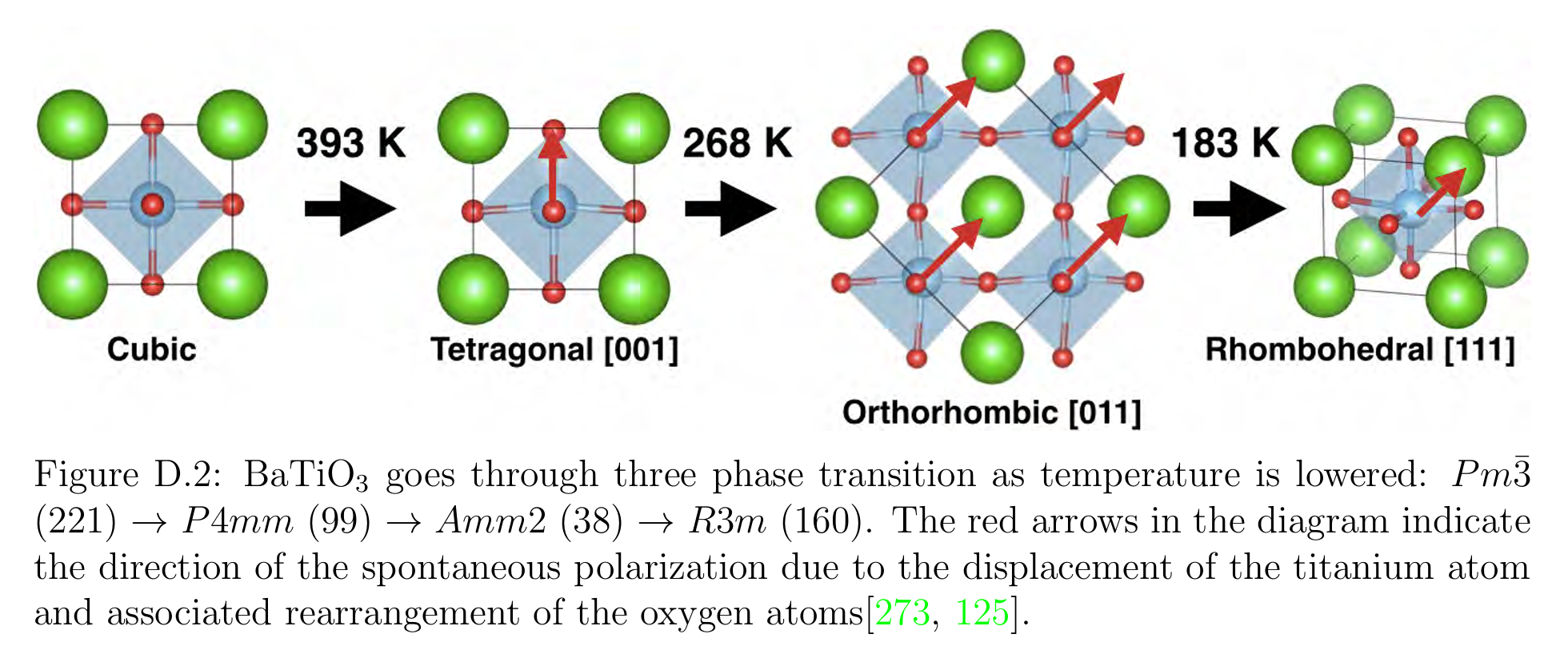
BaTiO_3 undergoes not one but three successive phase transitions, each lowering the symmetry further. We can describe these using space groups (the full symmetry including translations in the crystal lattice):
Each space group has an associated point group — the rotational/mirror symmetries that remain after factoring out translations. The point group is what determines the irreps and character tables we use for analysis:
Each of these point groups is a subgroup of the parent O_h, and we can use branching rules O_h \to H to determine which vibrational modes of the cubic structure drive each transition.
An important subtlety: while C_{4v} and C_{2v} form a subgroup chain (C_{2v} \subset C_{4v} \subset O_h), the final phase C_{3v} is not a subgroup of C_{2v}. The rhombohedral phase is a separate branch of the O_h subgroup tree — both C_{2v} and C_{3v} are subgroups of O_h, but neither contains the other. In general, the sequence of phases observed as temperature decreases need not follow a single subgroup chain. What we will use to understand the soft modes driving each transition is that each phase corresponds to a subgroup of the original high-symmetry structure.
1.3) Why It Matters: New Properties from Broken Symmetry
These structural distortions aren't just crystallographic curiosities — they give rise to physical properties that the high-symmetry phase cannot support:
- Ferroelectricity: a spontaneous electric polarization that can be switched by an applied electric field. The cubic phase of BaTiO_3 has no polarization; the tetragonal phase does. This is the basis of non-volatile memory (FeRAM).
- Piezoelectricity: the ability to generate voltage from mechanical stress (and vice versa). Used in sensors, actuators, sonar, and ultrasound imaging.
- Pyroelectricity: a change in polarization with temperature, used in infrared detectors.
All of these properties are forbidden by symmetry in the high-symmetry cubic phase and only become possible once symmetry is broken. This is a deep and general principle: new properties emerge when symmetry is reduced.
1.4) Curie's Principle
This connection between symmetry and physical properties was formalized in 1894 by Pierre Curie (Marie Curie's husband and co-Nobel laureate) in his paper "Sur la symétrie dans les phénomènes physiques" (Curie, 1894):
Curie's Principle: "When certain causes produce certain effects, the elements of symmetry of the causes must be found in the effects produced." (translation from Chalmers, 1970)
Original French: "Lorsque certaines causes produisent certains effets, les éléments de symétrie des causes doivent se retrouver dans les effets produits."
The contrapositive is more useful in practice: a physical property can only exist if the system's symmetry allows it. We can check this using irreps. For example, can a crystal support a spontaneous electric polarization (a vector)?
A vector (x, y, z) transforms as the vector representation of the point group. For a vector to be a permanent property of the crystal (not just an oscillation), it must transform as A_1 (the trivial irrep).
- In cubic O_h: (x, y, z) transforms as T_{1u}, not A_1 — the cubic phase cannot support spontaneous polarization.
- In tetragonal C_{4v}: z transforms as A_1 — the tetragonal phase can support polarization along z.
This is exactly what happens in BaTiO_3: the cubic-to-tetragonal transition at 393 K enables ferroelectricity.
1.5) Spontaneous Symmetry Breaking and Domains
When a mode freezes, there are often multiple equivalent ways to break the symmetry. The number of equivalent choices is determined by how many copies of the subgroup H sit inside the parent group G, given by \lvert G \rvert / \lvert H \rvert. The BaTiO_3 phase transitions make this concrete:
-
Cubic \to tetragonal (O_h \to C_{4v}): the polarization points along a cube face normal — the [001] direction. But a cube has 6 faces, so there are 48/8 = 6 equivalent choices (\pm x, \pm y, \pm z). Nothing in the cubic parent structure distinguishes +z from -z or from +x — all 6 are equally likely.
-
Cubic \to orthorhombic (O_h \to C_{2v}): the polarization points along a cube edge direction — [011]. A cube has 12 edges, giving 48/4 = 12 equivalent domain orientations.
-
Cubic \to rhombohedral (O_h \to C_{3v}): the polarization points along a body diagonal — [111]. A cube has 8 corners (4 body diagonals \times 2 directions), giving 48/6 = 8 equivalent choices.
In a real crystal, different regions may independently choose different orientations, creating domains. Statistically, all equivalent orientations are equally populated across the material. An external field (strain, electric field, etc.) can bias the system toward one domain over others — this is how we "pole" a ferroelectric or piezoelectric material for use in devices.
The direction of the frozen distortion serves as the order parameter of the phase transition.
1.6) Curie's Principle and Equivariant Neural Networks
Curie's principle isn't just a statement about crystals — it applies to any system that respects symmetry, including neural networks. If a neural network f is equivariant under a group G, then it provably obeys Curie's principle: the symmetry of the output is always equal to or higher than the symmetry of the input,
This means equivariant networks can be used to solve symmetry-breaking problems: given a high-symmetry input, the network's output and gradients can identify the order parameters that break symmetry, without ever being told which subgroup to look for. This was first demonstrated for steerable (irrep-based) equivariant networks in Smidt, Geiger, and Miller (2021), where Euclidean neural networks were trained to learn symmetry-breaking distortions — including deforming a square into a rectangle (D_4 \to D_2, the same example we work through below) and generating octahedral tilting patterns in perovskites.
This was later generalized from steerable networks to group convolutions in Wang, Hofgard, Gao, Walters, and Smidt (ICML 2024). The key idea is relaxed group convolutions: the network starts fully equivariant (all per-element weights w_l(h) equal), and the weights only deviate during training when the data has lower symmetry than the model. After training, the relaxed weights can be decomposed into irreps of the group to read off exactly which symmetries are preserved and which are broken — analogous to reading a character table. This approach was used to discover symmetry-breaking factors in BaTiO_3 phase transitions (the same O_h \to C_{4v} and O_h \to C_{2v} transitions discussed above), isotropy breaking at different length scales in turbulent flows, and time-reversal symmetry breaking in pendulum dynamics with friction.
Hands-on demonstration. The Steerable Convolution & Symmetry-Breaking Order Parameters Colab implements both approaches on the tetris classification task:
- Steerable order parameter: A frozen steerable network learns a single irrep-valued parameter that identifies the broken symmetry (B_1 for rectangles, B_2 for diamonds, A_2 for chirality).
- Relaxed group convolution: A frozen regular-rep network learns per-group-element lifting weights whose irrep decomposition reveals the same symmetry-breaking pattern.
Both approaches discover which symmetry is broken without being told — a concrete demonstration of Curie's principle in equivariant machine learning.
2) Subgroup-Preserving Distortions
We can use irreps to describe phase transitions and symmetry breaking more precisely. The central question is:
Key idea: Given a system with symmetry group G, how can we "distort" the system to have the symmetry of a subgroup H \subset G?
Irreps of group G can become reducible under subgroup H. Branching rules describe the mapping between irreps of G and irreps of H.
2.1) Which Irreps Break Which Symmetries?
The character table gives us a quick first pass. For a 1-dimensional irrep, characters can only be +1 or -1, and the interpretation is straightforward:
- \chi(g) = +1: the mode is invariant under symmetry operation g
- \chi(g) = -1: the mode breaks symmetry operation g
However, even for 1D irreps, remember that characters are constant across a conjugacy class. If a conjugacy class contains multiple distinct operations (e.g., "2\sigma_v" groups two different mirror planes), the character tells you that both are preserved or both are broken — but to know which specific mirrors these are, you need to go back to the actual representation matrices or the geometric description of the group elements.
For higher-dimensional irreps, characters are even less directly informative:
- \chi(g) = \text{dim} (e.g., \chi = 2 for a 2D irrep): the representation matrix is the identity, so the mode is fully invariant under g.
- \chi(g) \neq \text{dim}: some symmetry is broken, but the character alone doesn't tell you exactly how. A 2D irrep might have \chi(C_4) = 0, which means the trace of the 2 \times 2 representation matrix is zero — but the two components of the mode are being mixed in a way that requires the full matrix to understand. In these cases, you generally need to work with the representation matrices (not just characters) and use the branching rules to determine which specific symmetries are preserved.
Rule: A mode transforming as irrep \Gamma of G can "freeze out" to produce a structure with subgroup H if and only if \Gamma restricted to H contains A_1^H (the trivial irrep of H). For 1D irreps, this simply means \chi(h) = +1 for every h \in H. For higher-dimensional irreps, you must restrict the representation matrices to the elements of H and decompose.
3) Worked Example: Reading the D_4 Character Table
This is the pedagogical heart of symmetry-breaking analysis. We walk through how to read character tables to determine which modes produce which distortions.
3.1) The D_4 and D_2 Character Tables
D_4 is the symmetry group of the square (8 elements, 5 conjugacy classes). D_2 is the symmetry group of the rectangle (4 elements, 4 classes).
| D_4 | E | 2C_4 | C_2 | 2\sigma_v | 2\sigma_d |
|---|---|---|---|---|---|
| A_1 | 1 | 1 | 1 | 1 | 1 |
| A_2 | 1 | 1 | 1 | -1 | -1 |
| B_1 | 1 | -1 | 1 | 1 | -1 |
| B_2 | 1 | -1 | 1 | -1 | 1 |
| E | 2 | 0 | -2 | 0 | 0 |
| D_2 | E | C_2 | \sigma_1 | \sigma_2 |
|---|---|---|---|---|
| A_1 | 1 | 1 | 1 | 1 |
| B_1 | 1 | 1 | -1 | -1 |
| B_2 | 1 | -1 | 1 | -1 |
| B_3 | 1 | -1 | -1 | 1 |
Here \sigma_v denotes the "side mirrors" (through midpoints of opposite edges) and \sigma_d denotes the "diagonal mirrors" (through opposite corners).
To see what each D_4 operation actually does, it helps to pick a concrete labeling. We place vertices at (\pm 1, \pm 1) and label them 1 through 4 counterclockwise from the top-right: 1 = [1,1], 2 = [-1,1], 3 = [-1,-1], 4 = [1,-1]. The interactive diagram below shows all 8 operations and their effect on the labeled square.
Click the operation buttons to see each symmetry operation as a before/after diagram with the symmetry element (mirror line or rotation) drawn on the square. The buttons are color-coded by their role in the D_4 \to D_2 reduction: green/bold operations (E, C_2) are always kept, red operations (C_4, C_4^3) are always broken, and blue operations (\sigma_v, \sigma_d) are the "choice" — we keep one pair and break the other. The bottom panel shows the resulting distortions and their \pm\mathbf{v} domain variants.
3.2) Step-by-Step: Reading the Tables
Step 1: Classify the columns. Going from D_4 to D_2, which operations survive?
- Keep (always in D_2): E and C_2
- Must break (not in any D_2 subgroup): 2C_4 — a rectangle does not have 4-fold rotational symmetry
- Choice: the two mirror classes. We keep one pair and break the other — this gives the two distinct D_2 subgroups of D_4.
Step 2: Check each irrep row. For each 1D irrep, look at the characters under the "must break" and "choice" columns:
-
B_1: \chi(C_4) = -1 (breaks C_4), \chi(\sigma_v) = +1 (preserves side mirrors), \chi(\sigma_d) = -1 (breaks diagonal mirrors). So B_1 is A_1 under the subgroup that keeps side mirrors. This distortion turns the square into a rectangle.
-
B_2: \chi(C_4) = -1 (breaks C_4), \chi(\sigma_v) = -1 (breaks side mirrors), \chi(\sigma_d) = +1 (preserves diagonal mirrors). So B_2 is A_1 under the subgroup that keeps diagonal mirrors. This distortion turns the square into a diamond.
-
A_2: \chi(C_4) = +1 but \chi(\sigma_v) = -1 and \chi(\sigma_d) = -1. It breaks both mirror classes but preserves C_4 — this corresponds to a distortion to C_4 symmetry (rotation without mirrors), not to D_2.
-
E: \chi(C_4) = 0 \neq 2, so the 2D mode breaks C_4, but the characters don't immediately tell us which subgroup it maps to. We need the full branching rules.
Step 3: Two D_2 subgroups. The two choices correspond to:
- Subgroup 1: \{E, C_2, \sigma_{v1}, \sigma_{v2}\} — keeps the side mirrors — distortion mode is B_1 (rectangle)
- Subgroup 2: \{E, C_2, \sigma_{d1}, \sigma_{d2}\} — keeps the diagonal mirrors — distortion mode is B_2 (diamond)
These two subgroups are related by a 45° rotation — neither is "preferred" by the group itself, which is the origin of spontaneous symmetry breaking.
3.3) Interactive: Character Table Analysis
The interactive graphic below walks through this analysis step by step, with color-coded columns and small distortion diagrams:
4) The Distortion Modes
Now let's visualize the actual atomic displacement patterns for the modes that take D_4 \to D_2.
4.1) B_1 Mode: Rectangle
The B_1 mode stretches the square along one axis and compresses along the perpendicular axis, producing a rectangle. It preserves the side mirrors \sigma_v and breaks the diagonal mirrors \sigma_d and the 4-fold rotation C_4.
There is one B_1 vibrational mode of the 4-atom square. This is an in-plane distortion.
4.2) B_2 Modes: Diamond and Folded Square
The B_2 modes preserve the diagonal mirrors \sigma_d and break the side mirrors \sigma_v and C_4. There are two B_2 vibrational modes:
- Diamond (in-plane): atoms move outward along the diagonals, turning the square into a diamond (rhombus).
- Folded square (out-of-plane): opposite corners move up and down alternately, folding the square along a diagonal.
Both B_2 modes transform identically under the group operations — they span two independent directions in the same irrep subspace.
4.3) Order Parameter
The sign of the frozen distortion (+\mathbf{v} or -\mathbf{v}) is the order parameter of the phase transition. Both directions are valid eigenmodes — the system spontaneously picks one. The two choices are related by the broken symmetry operations.
4.4) Interactive: Distortion Modes Viewer
The animated viewer below shows the three distortion modes oscillating. Toggle between top-down (xy) and side (xz) views to see the out-of-plane folded-square mode:
5) The Algorithmic Recipe
5.1) Three-Step Algorithm
Reading character tables by hand works well for small groups. For larger groups or automated workflows, we use a systematic algorithm:
-
Find all copies of H in G: identify every subgroup of G that is isomorphic to H. These may differ in their embedding (which specific elements of G they correspond to).
-
Get branching rules: for each embedding, restrict each irrep \Gamma_i^G to the elements of H and decompose the resulting (possibly reducible) representation into irreps of H.
-
Identify distortion modes: the irreps \Gamma_i^G \neq A_1^G that branch to A_1^H are exactly the symmetry-breaking modes that produce the G \to H phase transition.
5.2) Branching Rules Formally
The branching rule for irrep \Gamma_i^G under restriction to H is written:
where a_{ij} are non-negative integer multiplicities. These are computed by restricting the G irrep matrices to the elements of H, then decomposing using the character orthogonality formula:
5.3) D_4 \to D_2 Numerical Results
For our square example, there are two subgroups of D_4 isomorphic to D_2. The branching tables are:
Subgroup 1 (keeps side mirrors \sigma_v):
| D_4 irrep | D_2 decomposition |
|---|---|
| A_1 | A_1 |
| A_2 | B_1 |
| B_1 | A_1 |
| B_2 | B_1 |
| E | B_2 + B_3 |
Subgroup 2 (keeps diagonal mirrors \sigma_d):
| D_4 irrep | D_2 decomposition |
|---|---|
| A_1 | A_1 |
| A_2 | B_1 |
| B_1 | B_1 |
| B_2 | A_1 |
| E | B_2 + B_3 |
Notice:
- Under Subgroup 1: B_1^{D_4} \to A_1^{D_2} — the rectangle mode becomes trivial (this is the distortion mode).
- Under Subgroup 2: B_2^{D_4} \to A_1^{D_2} — the diamond mode becomes trivial.
- In both cases, the 2D irrep E of D_4 splits into B_2 + B_3 of D_2. This degeneracy lifting is directly observable in spectroscopy.
Physically: Modes that were degenerate (same energy) in the square become non-degenerate in the rectangle. The two E modes split into separate energy levels — observable as peaks that were previously merged becoming resolved in spectroscopy.
6) Summary
The three-step recipe for symmetry-breaking analysis:
- Identify the subgroup H \subset G and find all embeddings of H in G.
- Determine branching rules — how each irrep of G decomposes under restriction to H.
- Find which vibrational modes become A_1^H — these are the symmetry-preserving distortions that connect the two phases.
Curie's principle ties everything together: a system can only possess a physical property (polarization, magnetization, strain) if its symmetry group allows it. Symmetry breaking via mode freezing is the mechanism that enables new properties to emerge.
Related exercises: Representations II